User account menu
Main navigation
  • Topics
    • Customer Care
    • FDA Compliance
    • Healthcare
    • Innovation
    • Lean
    • Management
    • Metrology
    • Operations
    • Risk Management
    • Six Sigma
    • Standards
    • Statistics
    • Supply Chain
    • Sustainability
    • Training
  • Videos/Webinars
    • All videos
    • Product Demos
    • Webinars
  • Advertise
    • Advertise
    • Submit B2B Press Release
    • Write for us
  • Metrology Hub
  • Training
  • Subscribe
  • Log in
Mobile Menu
  • Home
  • Topics
    • 3D Metrology-CMSC
    • Customer Care
    • FDA Compliance
    • Healthcare
    • Innovation
    • Lean
    • Management
    • Metrology
    • Operations
    • Risk Management
    • Six Sigma
    • Standards
    • Statistics
    • Supply Chain
    • Sustainability
    • Training
  • Login / Subscribe
  • More...
    • All Features
    • All News
    • All Videos
    • Contact
    • Training

3D Research Is Smooth as Glass

The first step to print compositionally graded glass optics

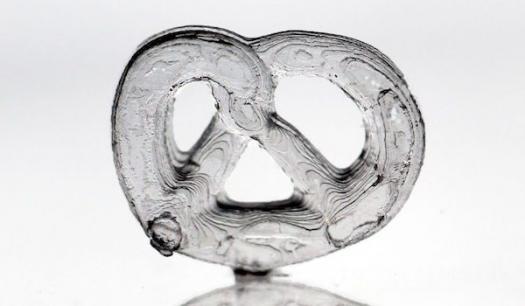
Complicated high-precision structures made of glass, like this pretzel, can be manufactured in a 3-D-printing process developed at Karslruhe Institute of Technology. Credit: Karslruhe Institute of Technology
The American Ceramic Society
Mon, 06/12/2017 - 12:01
  • Comment
  • RSS

Social Sharing block

  • Print
Body

Almost two years ago, Micron3DP demonstrated one of the earliest forays into 3D printing with glass. Just a few months later, MIT backed up glass’s place in the additive manufacturing realm and showed just how beautiful the possibilities were.

ADVERTISEMENT

Although intriguing, those early demonstrations were only able to produce rather imprecise glass components with poor resolution (on the order of millimeters) because they printed in molten glass.

Although that’s good enough for glass vases, bowls, and other artistic expressions, it just doesn’t cut it for the wide range of high-tech applications of glass that require intricate and precise microstructures.

To really open up the world of additive manufacturing for glass, we need techniques that can print with better resolution, precision, and detail, which is hard to achieve with molten glass.

 …

Want to continue?
Log in or create a FREE account.
Enter your username or email address
Enter the password that accompanies your username.
By logging in you agree to receive communication from Quality Digest. Privacy Policy.
Create a FREE account
Forgot My Password

Add new comment

4 + 15 =
Solve this simple math problem and enter the result. E.g. for 1+3, enter 4.
Please login to comment.
      

© 2024 Quality Digest. Copyright on content held by Quality Digest or by individual authors. Contact Quality Digest for reprint information.
“Quality Digest" is a trademark owned by Quality Circle Institute Inc.

footer
  • Home
  • Print QD: 1995-2008
  • Print QD: 2008-2009
  • Videos
  • Privacy Policy
  • Write for us
footer second menu
  • Subscribe to Quality Digest
  • About Us
  • Contact Us